

The Books That Make the Startup Framework Feel Real
StartupBox Books are designed as a narrative learning system — not as isolated startup guides. Across these three books, the Parallel Ventures Startup Framework moves from concept to lived experience through the founder journey of Priya and Rohan.
This matters because real entrepreneurship is rarely linear. Founders loop back, stall, accelerate, pivot, rebuild, and evolve. The framework gives structure and language. The founder journeys give context, realism, and emotional truth. Together, they create learning that feels experienced — not merely explained.
For universities, incubators, and entrepreneurship missions, this becomes institution-friendly learning: shared reference material, discussion anchors for cohorts, and a story-led curriculum that keeps founders engaged while remaining grounded in practical execution.
Why This Works (for Founders and Institutions)
- Framework-led, story-anchored: concepts land faster when founders can see the decision context and consequences.
- Designed for facilitation: chapters naturally convert into cohort discussions, mentoring prompts, and workshop themes.
- Realistic, not idealistic: shows trade-offs, uncertainty, and imperfect choices — the way startups actually move.
- Stage-aware learning: supports founders across validation, early revenue, growth, resilience, and leadership evolution.
- Institution-friendly structure: enables a shared language across mentors, programme teams, and founders — without forcing a one-size-fits-all journey.
For Institutions Evaluating StartupBox
Universities, incubators, accelerators, and ecosystem partners can request an Institutional Evaluation Set of the StartupBox books.
This set is intended for programme heads, mentors, and decision-makers who want to review the framework, structure, and pedagogy before exploring institutional adoption.
Meet Priya and Rohan — The Story Behind the Insights
Building a venture is not only about numbers, strategy, or funding — it is about the people who take the leap. In the StartupBox Books, you follow the journey of Priya and Rohan as they navigate the uncertainty, the trade-offs, the breakthroughs, and the small wins that eventually create real momentum.
Their story reflects real-world startup challenges. It brings the Parallel Ventures Startup Framework to life by showing how founders actually move through clarity, validation, building, monetisation, growth, setbacks, leadership, and resilience.

Priya Sharma — The Dreamer with a Vision
Priya cares deeply about solving problems — but turning an idea into a venture is unfamiliar territory. She brings energy, curiosity, and the willingness to do the work, while also carrying what many first-time founders carry: uncertainty, market doubts, and fear of failure.
Across the books, Priya grows from an aspiring entrepreneur into a more confident founder — one who learns to validate ideas, listen to the market, make decisions with incomplete information, and still move forward with intent.

Rohan Malhotra — The Strategist Who Needs Convincing
Rohan is analytical, practical, and deeply aware of risk. He thinks in terms of revenue models, scalability, and financial stability — and he represents many professionals who want to explore entrepreneurship without betting recklessly.
Through the journey, Rohan learns that structured execution, sound thinking, and stage-aware decision-making can bridge the gap between uncertainty and progress — without blind risk-taking.
Why Their Story Matters
Priya and Rohan's journey is not “story for entertainment”. It is a learning device that mirrors the challenges, mistakes, and breakthroughs most founders experience — often in silence.
- It helps founders recognise themselves and name what they are experiencing.
- It makes frameworks and tools easier to apply because the context feels real.
- It strengthens cohort discussions and mentoring conversations for institutional programmes.
- It turns startup learning into something founders can relate to and act on.
How the Books and the Startup Framework Work Together
The Parallel Ventures Startup Framework provides the structure — the tracks, the progression logic, and the shared language that helps founders (and institutions) make sense of what to do next.
The books do something equally important: they make that structure feel lived. Through Priya and Rohan, readers experience how startup work actually unfolds — the uncertainty, the trade-offs, the imperfect decisions, and the moments where founders loop back to regain clarity before moving forward.
When used together, the framework becomes easier to apply, easier to teach, and easier to mentor. It stops being a set of ideas and becomes a practical lens for real-world founder progress.
What the Framework Provides
- A shared model to support founders across different stages and speeds
- Clear tracks and themes that organise startup work into teachable modules
- A common language for mentors, programme teams, and founders
- Tools and thinking models that translate insight into action
- A progression lens — without forcing linear journeys
What the Founder Journeys Provide
- Decision context — what founders were really dealing with in that moment
- Realistic trade-offs, not idealistic steps
- Emotional realism — doubt, urgency, pressure, and resilience
- Pattern recognition through story, not theory
- A natural bridge into discussion, reflection, and mentoring conversations
Together, they create a complete learning system: the framework shows the landscape, the books show what it feels like to move through it. This combination makes StartupBox particularly effective for institutional programmes where learning must be both structured and engaging.
The Three Books Inside StartupBox
Each book plays a distinct role. Together, they cover the full founder journey — from early clarity and validation to growth, resilience, leadership, and long-term direction. Priya and Rohan's story threads through the learning, while the framework ensures the work stays structured, practical, and teachable.
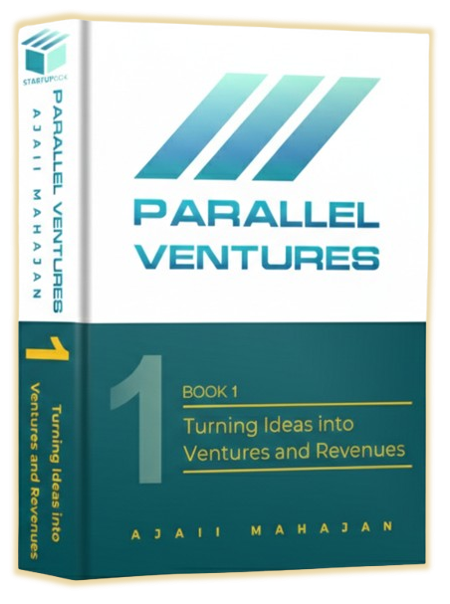
Book 1: From Idea to First Revenue
Turning Ideas into Ventures & Revenues
This book captures the earliest, most fragile phase of entrepreneurship — when clarity is incomplete, confidence is uneven, and everything feels possible and risky at once. Through Priya and Rohan's journey, founders learn how to choose a direction, validate real problems, build the first version, and earn early traction without confusing activity with progress.
What founders experience inside Book 1:
- Making sense of too many ideas and choosing one direction to explore
- Validating problems and markets before committing to a full build
- Designing a first offering or MVP and learning through feedback loops
- Understanding customers beyond assumptions and surface signals
- Reaching first traction and early revenue through practical execution
Framework alignment: Clarity • Build • Sell (early stage)
Best suited for: Aspiring founders, early-stage startups, student entrepreneurs, pre-incubation cohorts
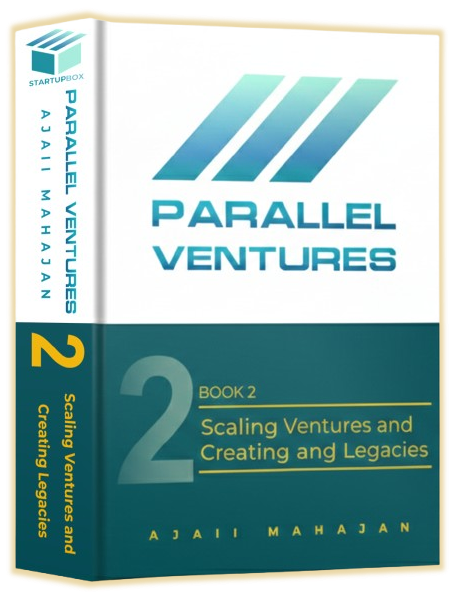
Book 2: From Traction to Scale
Scaling Ventures & Creating Legacies
Once momentum begins, new challenges emerge — growth pressure, people decisions, financial discipline, and the weight of leadership. This book follows Priya and Rohan as they learn to scale without losing direction, build systems and culture, navigate setbacks, and grow into the role their venture now demands.
What founders experience inside Book 2:
- Scaling execution without compromising quality and customer experience
- Building teams, systems, and processes that reduce founder dependency
- Developing cash flow clarity, financial controls, and operational discipline
- Navigating setbacks, pivots, competition, and unpredictable market shifts
- Evolving leadership style, culture, and decision-making under pressure
Framework alignment: Scale • Shift • Founder Wellness • Amplify
Best suited for: Growth-stage founders, incubators, accelerators, MSME programmes, leadership cohorts
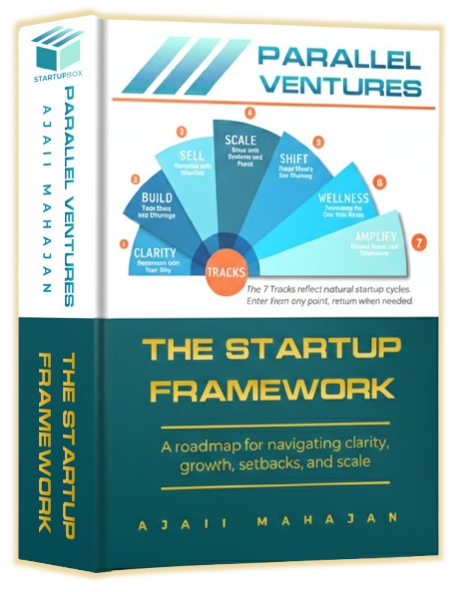
Book 3: The Startup Framework
A Structured Model for Founder & Venture Growth
This is the backbone of StartupBox. It distils years of founder engagement into a clear, modular, and teachable system that institutions can deploy across cohorts, programmes, and mentor networks — while still allowing founders to move at their own pace and stage.
What the Framework book enables:
- A complete view of the 7 framework tracks and how they connect
- Decision logic and stage-aware guidance for founders and mentors
- Tools, assessments, and thinking models that translate insight into action
- A shared language for programme design, facilitation, and mentoring
- A foundation for structured institutional deployment at scale
Framework alignment: All tracks (Clarity, Build, Sell, Scale, Shift, Founder Wellness, Amplify)
Best suited for: Universities, startup missions, incubators, mentors, programme teams, ecosystem partners
Designed for Institutional Deployment
StartupBox Books are built not only for individual founders, but for the realities of institutional entrepreneurship programmes. They are structured to work across cohorts, timelines, mentor styles, and founder maturity levels — without requiring rigid sequencing or one-size-fits-all pathways.
This makes them particularly effective for universities, incubators, accelerators, and government-led entrepreneurship missions that need learning systems which are both scalable and human.
What Institutions Gain
- A shared learning foundation across founders, mentors, and programme teams
- Story-led material that keeps founders engaged beyond compliance-driven sessions
- A common language that simplifies mentoring, reviews, and progress discussions
- Flexibility to support founders moving at different speeds and stages
- Content that integrates naturally with workshops, assessments, and mentoring
What Programme Teams Avoid
- Overly academic material that founders struggle to relate to
- Linear curricula that fail to reflect real startup movement
- Frameworks that mentors interpret inconsistently
- Content that works only at one narrow stage of the startup journey
- Low engagement once formal sessions end
Because the books are anchored in real founder journeys and aligned to a clear framework, they scale naturally across programmes — while still feeling personal to each founder reading them.
How Institutions Typically Use StartupBox Books
StartupBox Books are intentionally designed to fit into real-world programme constraints — limited time, diverse founder profiles, varying mentor styles, and non-linear founder progress. Institutions adopt them in different ways, depending on programme structure and maturity.
As Core Reading for Founder Cohorts
Books are issued at programme entry and used as a common reference throughout the cohort. Founders read selectively based on their stage, while mentors and programme teams anchor discussions around shared chapters and framework tracks.
As Workshop and Discussion Anchors
Specific chapters become pre-reads or post-session material for workshops. Story-led context makes sessions more grounded, while the framework helps translate discussion into concrete next steps for founders.
As Mentor Reference Material
Mentors use the books as a shared baseline to align advice and language. This reduces conflicting guidance, improves mentoring consistency, and helps mentors contextualise founder decisions within a broader journey.
As Self-Paced Learning Resources
Between sessions and beyond formal programme timelines, founders continue using the books as personal reference material — revisiting chapters as their context changes and new challenges emerge.
As a Bridge Between Cohorts and Stages
The same books stay relevant as founders move from validation to growth. This continuity helps institutions support long-term founder journeys without repeatedly resetting learning material at each stage.
As a Programme Design Reference
Programme teams use the framework book to shape curriculum flow, session sequencing, assessment points, and mentoring checkpoints — while keeping founder experience central to design.
Unlike most startup books that talk about theories, Parallel Ventures is filled with real, actionable insights. Every chapter feels like a masterclass in entrepreneurship, guiding you step by step through the journey of building a successful business.
Rajat Khanna
Startup Founder
This book is a must-read for anyone looking to start a business while managing a full-time job. It breaks down the process into practical steps, making it easier to transition from an idea to a sustainable venture.
Neha Choudhary
Entrepreneur & Consultant
What I loved most about Parallel Ventures is its storytelling approach. Following Priya and Rohan's journey made the insights incredibly relatable. It felt like I was learning from real entrepreneurs rather than just reading another business book.
Vikram Mehta
Aspiring Entrepreneur
This book gave me the clarity I needed to move forward with my startup. The lessons on validation, monetization, and scaling are incredibly valuable. A must-read for any founder who wants to build a business that lasts!
Aditi Jain
Founder at UpSkillEd
StartupBox Is More Than Books
The books form the foundation layer of StartupBox — they create the shared language, the lived context, and the narrative continuity that founders and institutions need.
But StartupBox goes further. It turns learning into execution through a deployable system that includes the framework, facilitated workshops, founder tools, and programme design support — allowing institutions to strengthen entrepreneurship outcomes at scale.
What StartupBox Enables
- A single deployable learning system that founders can enter at different stages and progress through over time
- Structured programmes and workshops aligned to the framework tracks — without rigid linear curriculum design
- Mentor alignment and consistency through shared language, tools, and stage-aware guidance
- Higher founder engagement because learning is anchored in lived founder reality, not abstract advice
- Continuity across cohorts using the same system for validation, revenue, growth, resilience, and leadership evolution
If your goal is to build entrepreneurship capability at scale — across students, aspiring founders, and early-stage startups — StartupBox offers a practical, story-anchored system that can be deployed across programmes and geographies.
Order an Institutional Evaluation Set
StartupBox Books are written as guidebooks for founders and are used by institutions as a shared reference system to strengthen cohort alignment, mentor consistency, and programme delivery.
The Institutional Evaluation Set is priced at ₹5,000 (inclusive of shipping). Payment is collected in advance. An invoice is issued in the billing name and address provided and is sent along with the evaluation copy.
Use the form below to request an evaluation set. After submitting the form, you will be redirected to complete payment and confirm dispatch.
Note: The Institutional Evaluation Set is offered for institutional review only. Retail sales are currently not supported.
Frequently Asked Questions
These questions help clarify how StartupBox Books are meant to be used — by founders directly, and by institutions that support founder journeys.
Who are StartupBox Books written for?
The books are written first and foremost as guidebooks for founders. They follow real founder decisions, challenges, and trade-offs — and are meant to be read, applied, and revisited by founders as their journey evolves.
If they are founder guidebooks, how do institutions use them?
Because the books are grounded in real founder experience and aligned to a clear framework, institutions use them as a shared reference. This creates common language, stronger cohort alignment, and more consistent mentoring — without turning the books into formal textbooks.
Do founders need to read all three books?
No. Founders typically engage with sections that match their current stage. The books are designed to be non-linear, allowing founders to move back and forth as their context changes.
Are these books meant to replace structured programmes or courses?
No. StartupBox Books are not courseware. They work best as companion guides that founders return to — supporting programmes, mentoring, and workshops rather than replacing them.
Can the books be used across different founder stages?
Yes. The journey spans early clarity, validation, revenue, growth, setbacks, and leadership. Founders and mentors often return to earlier sections as new challenges emerge.
What is the Institutional Evaluation Set meant for?
The evaluation set allows institutions to review the books in their natural form — as founder guidebooks — and assess how they might support cohorts, mentoring structures, or long-term founder journeys.
Does using the books require changes to existing programmes?
No. The books are designed to integrate into existing ecosystems without structural change. They add continuity and depth rather than forcing a new curriculum model.